
Research area 01

Nanoparticle synthesis and design

We develop colloidal routes for inorganic nanomaterials and control their composition, morphology, crystal structure, and surface functionality.

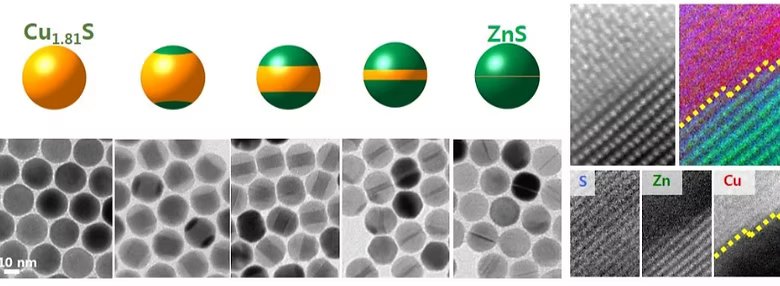
Cation-exchange transformation from copper sulfide to zinc sulfide nanocrystals
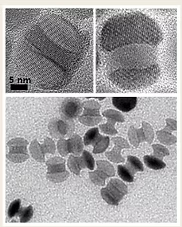
Transmission electron microscopy images of transformed heterostructured nanocrystals
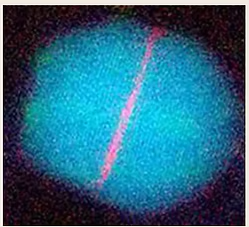
Elemental mapping image of a nanoscale heterostructure
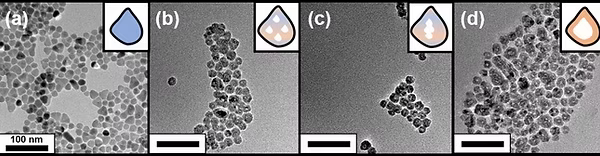
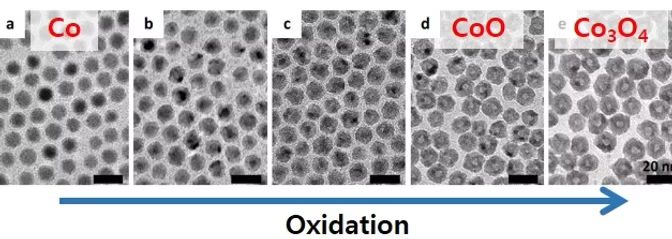
Oxidation sequence from cobalt nanoparticles to cobalt oxide nanomaterials

Designing new nanomaterials through chemical modulation

We use post-synthetic chemical reactions to transform pre-formed nanocrystals into new materials while preserving or deliberately modifying their nanoscale morphology.

Solid–solid phase transformation

Cation exchange, oxidation, and strain-driven conversion are used to produce new phases and heterostructures from existing nanocrystal templates.

Composition and morphology control

Secondary transformation provides an effective route to tune elemental composition, crystal phase, interfaces, and particle shape beyond direct synthesis.

Representative systems

Current examples include cation-exchange reactions in copper sulfide nanocrystals and oxidation-induced conversion of Co nanoparticles into CoO and Co₃O₄.
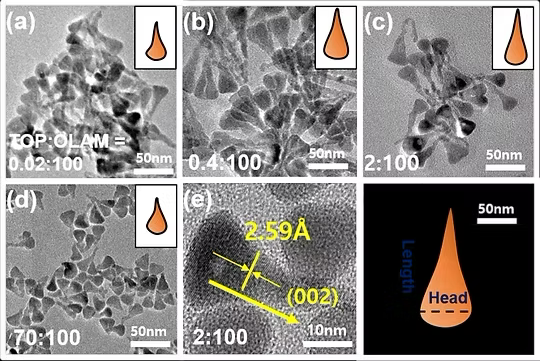
Morphology-controlled nanoparticle synthesis under different reaction conditions
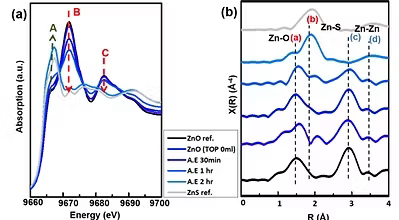
X-ray absorption spectroscopy and structural analysis of synthesized nanoparticles
Transmission electron microscopy series showing nanoparticle morphology changes
Schematic illustration of post-synthetic nanoparticle surface transformation
Fluorescently functionalized magnetic nanoparticle solutions

Nanoparticle synthesis and functionalization

We develop colloidal synthesis methods that control particle size, morphology, crystallinity, and surface chemistry for energy and functional-material applications.

Morphology-controlled synthesis

Reaction conditions, precursor chemistry, ligands, and solvent environments are adjusted to regulate nucleation, growth, and anisotropic particle formation.

Post-synthetic chemical transformation

Nanoparticles are used as reactive templates for the preparation of structures and compositions that are difficult to obtain through direct synthesis.

Functional nanomaterials

Surface modification and fluorescent functionalization are applied to magnetic nanoparticles such as Fe₃O₄ for potential energy, sensing, and biomedical applications.