
Fabrication of electrode for Proton Exchange Membrane Water Electrolyzer (PEMWE)
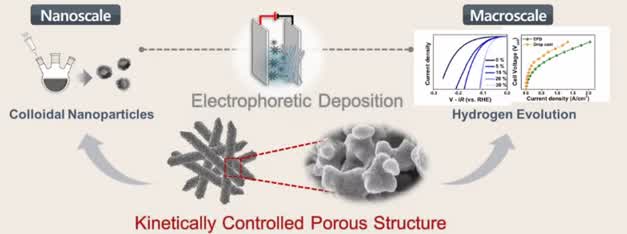
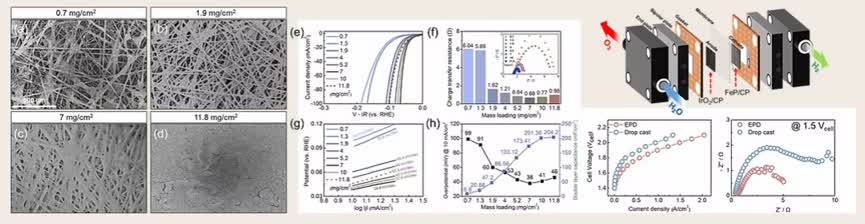
The inherent properties of nanoparticles (NPs) can be engineered into macroscopic structures by capturing the collective characteristics of the nanomaterials via a fabrication process to realize macroscopic functionality. We report a powerful manufacturing technique for fabricating an electrocatalytic electrode composed of highly porous iron phosphide (FeP) NP catalyst layers conformally deposited on macroporous carbon paper (CP) that shows excellent hydrogen evolution reaction activity.
The surface morphology and porosity of the FeP NP catalyst layers on the FeP/CP electrode were tuned by altering the deposition kinetics of the colloidal FeP NPs by controlling the solvent system in the electrophoretic deposition process. The FeP/CP electrode achieved a low overpotential of 38 mV at 10 mA cm−2 in 0.5 M H2SO4 due to the highly exposed catalytic surface with a large catalyst loading amount and fast charge transfer. When the FeP/CP electrode was applied as a cathode gas diffusion electrode (GDE) in a proton exchange membrane water electrolyzer (PEMWE), the single-cell exhibited excellent operating performance (1.48 A cm−2 @ 2.0 Vcell, 90°C). Our fabrication process to produce electrocatalytic electrodes with a controlled solvent system provides the opportunity for various non-precious colloidal NP catalysts to be realized as highly efficient GDEs in low-cost PEMWEs.