
Electrophoretic Deposition of Aged and Charge Controlled Colloidal Copper Sulfide Nanoparticles
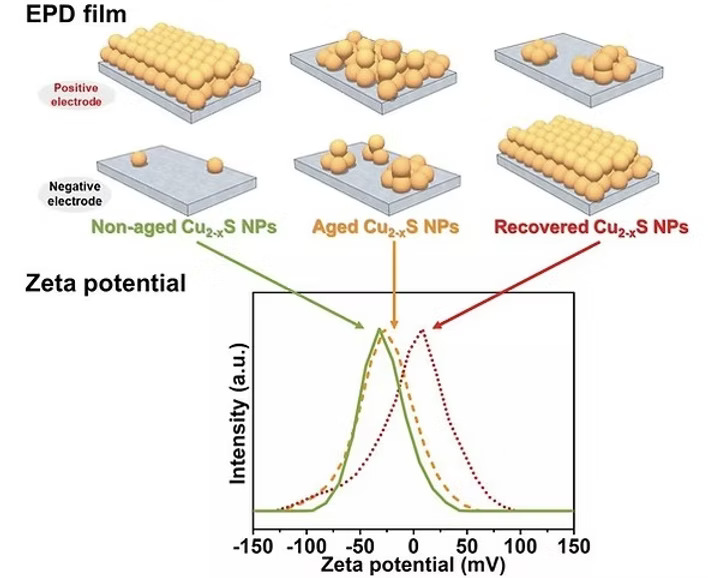
The aging process of colloidal Cu2-xS nanoparticles (NPs) were shown to result in different NP deposition behaviors by altering the charge states of oxidized NPs in the initial stage of aging. The aging state of the NPs was shown to be a key parameter in determining the direction of particle movement and the type of interparticle interactions during EPD. Moreover, a comparison of the NP films fabricated from aged NPs with and without ligand engineering process and zeta potential distributions collected from aged and recovered samples revealed that the surface ligands play an even more significant role in the charge formation than does the oxidation of the NPs due to aging. In conclusion, the ligand engineering of colloidal NPs is a key component of the EPD process for controlling charge formation and generating a uniform NP film from aged NPs via a restoration.